
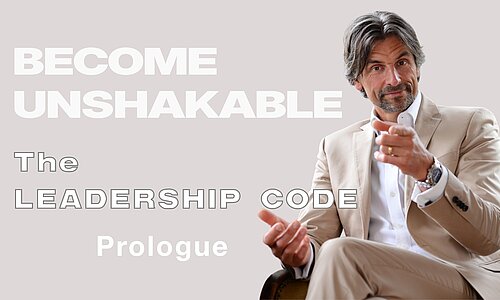
The Leadership Code - Prologue

Leadership Has Changed. Human Nature Hasn’t.
Dear CEOs, Leaders, and Decision-Makers,
Agile Leadership.
Servant Leadership.
New Work.
Remote Leadership.
AI Leadership.
Every few years, new terminology, new methods, and new models emerge. And many of them provide valuable insights. But over the past months, a different question has increasingly occupied my mind:
Are we really discovering new leadership principles—or are we simply giving timeless principles new names?
Our working world is changing at extraordinary speed. Human nature, remarkably little. People want to trust. People seek direction. People experience conflict. People need purpose. People want to be seen and understood. People make good and bad decisions. And people carry responsibility for the consequences of their actions. That was true two thousand years ago. And it will remain true in the age of artificial intelligence.
1. Perhaps We Are Looking in the Wrong Place
We invest enormous energy in new leadership models. But perhaps the greater opportunity lies in asking a different question:
Which principles of effective leadership have survived generations, cultures, and technological revolutions?
That question fascinates me. Because the deeper I explore leadership, the more often I encounter principles that are remarkably old.
Responsibility.
Learning.
Trust.
Leadership.
Growth.
Value.
Terms that sound highly relevant today while describing fundamental human questions that have existed for generations.
2. One Foundation of My Work
An important foundation for my exploration of these questions is Die 12 NATURGESETZE zum ERFOLG© and the ASC-Methode® developed by Eric Adler.
Die 12 NATURGESETZE zum ERFOLG© describe a developmental journey through twelve principles: Verantwortung (responsibility), Lernen (learning), Wille (intention), Angriff (taking action), Vertrauen (trust), Wirklichkeit (perception of reality), Anpassung (adaptation), Führung (leadership), Ausgleich (balance), Wachstum (growth), Verteidigung (dealing with conflict), and Nutzen (creating value).
Remarkably, this development begins with the individual. With our own thinking. Our own behavior. Our own responsibility.
The Naturgesetz of Verantwortung, for example, describes how consciously examining our own patterns of thought can strengthen personal responsibility, self-regulation, and freedom of decision.
And that is exactly where leadership begins for me.
Before we lead others, we lead ourselves.
3. Then I Encountered Something Fascinating
The deeper I engaged with these principles, the more frequently I discovered parallels with a much older text: the Bible.
For thousands of years, Scripture has addressed questions such as:
How do we deal with responsibility? How do we lead people? How is trust created? How do we respond to failure and conflict? How do we serve others? How do we develop character? How do we create value for others?
Again and again, we encounter principles that sound remarkably contemporary. Jesus, for example, said:
“By their fruits you will recognize them.” — Matthew 7:16
That is a remarkable leadership standard.
Because leadership is ultimately revealed less by titles, methods, or presentations. It is revealed by its fruit.
4. What Are the Fruits of Your Leadership?
When we look at an organization, we can ask:
Do people take responsibility? Is trust growing? Are mistakes transformed into learning? Are conflicts handled constructively? Are people developing? Are decisions being made? Is collaboration improving? Is genuine value being created? Then we begin to see leadership. Or its absence. Perhaps one of the most important questions for CEOs and leaders is therefore:
What fruit does my leadership produce?
5. And Then Came AI
Artificial intelligence makes this question even more relevant. Because AI changes what we can do. But it hardly answers the question of who we want to be while doing it.
AI can provide information. People carry responsibility. AI can analyze options. People make decisions. AI can prepare communication. People create trust. AI can accelerate processes. People determine direction and purpose.
The more powerful our technology becomes, the more important the quality of our leadership becomes.
6. The Leadership Code
This is where my new journey begins. Over the coming editions, I want to explore a hypothesis:
What if the fundamental code of effective leadership was described thousands of years before the first management textbook was written?
I call this journey: THE LEADERSHIP CODE
This is not about renaming Die 12 NATURGESETZE zum ERFOLG or repackaging an existing model. Quite the opposite.
Die 12 NATURGESETZE zum ERFOLG and Eric Adler’s ASC-Methode® form an important foundation for this exploration.
In The Leadership Code, I want to examine these insights alongside timeless biblical leadership principles and then ask a third question:
What do these principles mean for CEOs, leaders, teams, and organizations in the 21st century?
This creates a connection between: proven principles of human development, biblical wisdom and modern leadership practice.
7. Perhaps We Need Fewer New Leadership Trends
Perhaps we need greater clarity about the principles that endure. Technologies will come and go. Management methods will change. Organizational structures will continue to evolve. But responsibility remains responsibility. Integrity remains integrity. Trust remains trust. Character remains character. And leadership remains human.
A Question to Reflect On
Think about the best leader you have encountered in your career.
What made that person exceptional?
Their position? Their expertise? Their methods?
Or was it qualities such as responsibility, integrity, courage, trust, clarity, and the ability to help people grow?
Perhaps that is where we find the first traces of a timeless Leadership Code.
Your Next Step
In the next edition, we begin where, in my view, all effective leadership begins: Verantwortung – Responsibility.
From “Who is to blame?" to ”What responsibility am I willing to take?"
Paul puts it remarkably clearly:
“For each one should carry their own load.” — Galatians 6:5
Before we lead organizations. Before we lead teams. Before we lead change. We lead one person: ourselves.
Welcome to THE LEADERSHIP CODE.

Comments
No Comments