
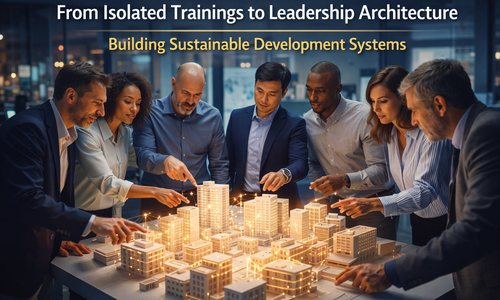
Developing Sustainable Leadership

Embedding Leadership Effectively: Turning Training into Sustainable Leadership Architecture
HR-Leadership-Series – Part 5
Dear HR leaders and executives,
Many organizations invest heavily in leadership programs.
The feedback is positive.
Participants feel inspired.
Concepts are understood.
Yet months later, one uncomfortable observation remains:
Observable leadership behavior has barely shifted at scale.
This is where most HR strategies reach a ceiling.
Because sustainable leadership is not built through events.
It is built through architecture.
1. Why Traditional Leadership Programs Plateau
Workshops generate insight.
Keynotes create momentum.
Toolkits provide structure.
But insight does not automatically change behavior.
Leadership behavior is shaped by:
- daily routines
- team expectations
- accountability structures
- cultural norms
Without structural reinforcement, even the best program fades under operational pressure.
“Do not merely listen… Do what it says.”
James 1:22
2. The Missing Link: Systemic Reinforcement
In working with HR teams across industries, one recurring pattern emerges:
- Strong individual leaders
- Clear competency models
- Well-designed training modules
Yet limited systemic integration.
The gap is rarely knowledge.
The gap is implementation within real teams.
That is precisely where a different development architecture becomes necessary.
3. What Sustainable Leadership Architecture Requires
A leadership system that creates measurable impact includes five core components:
a. Leadership Diagnostic Phase
A structured assessment of:
- team effectiveness
- leadership behavior under pressure
- collaboration patterns
- systemic friction points
Not generic surveys — but targeted analysis tied to business performance.
b. Real-Team Development Labs
Leadership development takes place with the actual leadership team.
Leaders work on:
- real strategic tensions
- unresolved conflicts
- accountability gaps
- role clarity
Behavior shifts because reality is addressed directly.
“As iron sharpens iron, so one person sharpens another.”
Proverbs 27:17
c. Embedded Reflection Cycles
Instead of one-off workshops, development unfolds over time:
- Structured reflection sessions
- Behavioral feedback loops
- Progress checkpoints
- Clear leadership commitments
Change becomes cumulative.
d. Leadership Language & Alignment Framework
A shared vocabulary for:
- accountability
- decision-making
- conflict navigation
- responsibility
This prevents leadership from becoming personality-driven.
e. Executive Sponsorship & HR Integration
Transformation succeeds only when:
- HR integrates leadership principles into talent processes
- Executive leadership models expected behavior
- Development aligns with strategic priorities
Sustainable leadership is a cross-functional effort.
“Whoever is faithful with little will also be faithful with much.”
Luke 16:10
4. How My Leadership Program Addresses This Gap
My program is not a training series.
It is a Leadership Effectiveness Architecture.
It combines:
- Diagnostic clarity
- Real-team development sessions
- Longitudinal coaching
- Structured accountability
- Measurable behavioral shifts
The goal is not inspiration.
The goal is behavioral transformation within real teams.
HR leaders I work with often describe the difference this way:
“For the first time, leadership development affected how teams actually operate.”
That is the shift from event-based development to systemic leadership impact.
5. The Strategic HR Question
The decisive question for HR becomes:
Are we investing in programs or are we building a leadership system?
Because the financial investment in development is already significant.
The real ROI comes when:
- collaboration improves
- decision speed increases
- conflict is handled constructively
- accountability becomes cultural
Sustainable leadership is not an event.
It is a designed ecosystem.
Strategic Reflection for HR Leaders
- Where does leadership behavior revert after training?
- Which teams underperform despite strong individuals?
- How integrated is leadership development with daily operations?
- Is development episodic — or architected?
If these questions resonate, the issue is not talent.
It is system design.
Preview – Part 6
In the final part of this series, we will explore:
How HR becomes the strategic driver of a high-performance leadership culture — and why this moment is decisive.

Comments
No Comments