

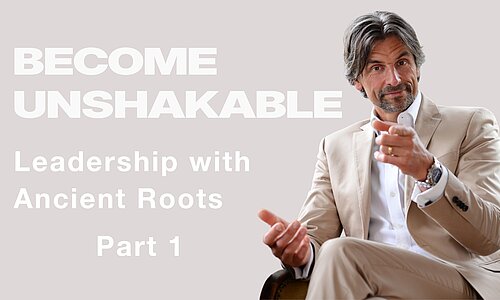
Leadership with Ancient Roots

Why the Best Leadership Principles Are Over 2000 Years Old
Newsletter Series: Part 1
Dear CEOs and leaders,
Leadership literature fills entire shelves today.
Every year new frameworks emerge:
- Servant Leadership
- Emotional Intelligence
- Authentic Leadership
- Empowerment
- Purpose-driven Leadership
The language is modern.
The concepts appear innovative.
Yet many of these principles are surprisingly ancient.
Some of the most powerful leadership insights were already articulated more than two thousand years ago.
One of the most influential sources is the Bible.
1. The Surprising Origin of Modern Leadership Ideas
Many contemporary leadership models describe principles that have existed for centuries.
Take the concept of servant leadership.
“Whoever wants to become great among you must be your servant.”
— Matthew 20:26
At first glance this idea appears counterintuitive.
In environments where leadership is often associated with authority and control, this perspective turns the traditional model upside down.
Yet modern leadership thinking increasingly reflects this principle.
Leadership is not primarily power over people.
It is responsibility for people.
2. Why This Principle Matters Today
Organizations have become more complex.
Leaders now work with:
- highly skilled experts
- autonomous teams
- rapid decision cycles
- growing uncertainty
In such environments, command-and-control leadership becomes less effective.
What emerges instead is a different leadership model:
Leadership as orientation.
Leadership as responsibility.
Leadership as stewardship.
3. Leadership as Responsibility
The Bible repeatedly frames leadership as responsibility.
“From everyone who has been given much, much will be demanded.”
— Luke 12:48
Applied to organizations, this means:
The greater the responsibility, the greater the impact of leadership decisions.
Leaders shape:
- decision quality
- conflict culture
- accountability
- organizational speed
Leadership always has consequences.
4. The Real Challenge of Leadership
Many leaders possess knowledge and tools.
The deeper challenge lies elsewhere:
- clarity of responsibility
- courage to decide
- ability to navigate tension
- commitment to shared purpose
These challenges are not new.
They have accompanied leadership for centuries.
5. A Provocative Thought
Many leadership books explain principles that have been known for a very long time.
The real difference lies not in knowledge.
The difference lies in whether leadership is lived consistently.
Another ancient insight captures this perfectly:
“By their fruits you will recognize them.”
— Matthew 7:16
Leadership is measured by outcomes.
Next Newsletter
In the next issue we will explore a critical leadership risk:
Why power without humility destabilizes organizations.

Comments
No Comments